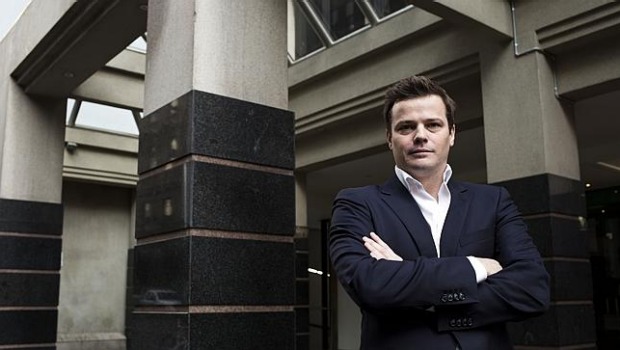
Some mornings before he went to work at UBS, Paul Barton was in such pain he would hobble or even crawl to the bathroom.
Once his medication had taken effect, he was functional and could manipulate his painful feet into his business shoes.
His next challenge was to get to the waiting taxi, which he shared with two other bankers, for the daily ride into the city.
Never disclosing his discomfort and shrugging off his limp as an old sporting injury, he would dread the walk across the foyer to the lifts at Sydney’s Chifley Tower.
By the time he made it to his desk in the equities advisory team, he was ready to stay put all morning.
Other days it wasn’t so bad and he could walk normally.
Barton had lived with chronic pain, on and off, throughout his life. At the age of seven he developed arthritis, slept in leg splints and remained unable to participate in sport until, at the age of 14, his arthritis disappeared as mysteriously as it had arrived.
It left a legacy and at 22, he developed gout which never completely cleared.
It would flare unexpectedly and become so painful he could not put any weight at all on the afflicted foot.
Hiding the pain
Banking is not an industry for the wounded and careful not to be perceived as such, for more than a decade Barton masked his condition with jokes and bonhomie.
All the while he took medication that devastated his gut.
Privately he sought help everywhere, in Australia and abroad, where he worked as an equities broker into the global financial crisis.
By the time he returned to Australia in 2009, he was at his wit’s end. By sheer serendipity, his mother-in-law was a general practitioner who specialised in an unconventional form of pain management.
She had pioneered of the use of low-level laser therapy (LLLT) in pain management and had long struggled for mainstream acceptance.
For most of her career, Roberta Chow has followed an orthodox path, sitting on regulatory committees and examining boards.
But when she came across LLLT in 1988, she was impressed by its effectiveness. Later, when she tried to get approval for it, she was surprised at how readily many of her colleagues dismissed it as quackery.
When the National Health and Medical Research Council issued a paper saying if people wanted to use alternate therapies they needed to provide evidence, she took the challenge.
Benefits of low-level lasers
At the age of 50, Chow, a mother of four, undertook a PhD at Sydney University on the use of LLLT in neck pain and then published her results in the journal, Pain. When she submitted another piece to the prestigious journal The Lancet, its editorial team was sceptical and for two years, the paper went back and forth for checking and revision.
Then, after having her work scrutinised by a forensic statistician, The Lancet published it.
The paper concluded that LLLT reduces pain immediately after treatment for acute neck pain.
It also reduces pain for up to 22 weeks after completion of treatment for chronic neck pain.
Chow went on to train further at the Pain Management and Research Centre of Sydney’s Royal North Shore Hospital and to publish in several journals. Over time, the therapy gained a little more acceptance and she lost interest in the fight for formal recognition, preferring instead to continue managing people’s pain in her practice in the Hills district of Sydney.
When LLLT started helping her son-in-law, he became interested in the modality, began researching it and attended an international conference on the subject.
As Barton sat in the conference of the World Association of Laser Therapy, a new domain opened before him.
Convinced this was the next generation of pain medicine, he decided to give up banking to dedicate himself to the business of making LLLT mainstream.
“When you are treated – and you are a responder – you just ‘get it’. I have been able to get on top of my health issue and can walk around without anticipating pain.
“Containing pain used to be my major focus and I never realised the impact it was having on my life until it went away.”
Barton and Chow have now opened a city clinic, Quantum Pain Management, which uses LLLT as a cornerstone therapy, as well as conventional treatments.
This form of laser therapy has been used for at least 30 years for pain reduction and tissue repair. There is strong evidence it works and new research is constantly being conducted to refine it.
Although little known in Australia, it is widely used in Japan and some Scandinavian and European countries.
Roberta Chow, an authority in the use of the laser therapy for pain, says it uses different lasers from those used in surgery.
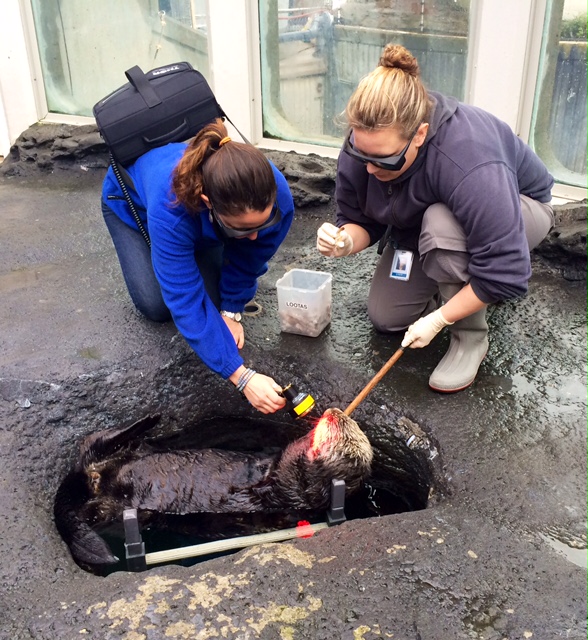
Surgical lasers use intense heat to ablate tissue. As the name suggests, low-level laser therapy , LLLT, uses low energy light. It emits no heat and is non-invasive. Some call it “cold laser”.
And one size does not fit all. Chow says the wavelength and the duration of exposure are determined by the condition that is being treated.
It works by blocking pain fibres and slowing the transmission of pain messages. This pain blockade has a flow-on effect and allows for a reduction in inflammation and for tissue regeneration.
“While stopping the pain allows the muscles to relax and anxiety to subside, it doesn’t mean patients are cured. No matter how good they feel, it takes six weeks for the repair processes to take place,” Chow says.
In one way, LLLT acts like a local anaesthetic and reduces pain signals going to the brain. But it aims to do more than that. The purpose is to program the pain system.
Chow says after several treatments the nerves in the affected area become less irritable and pain lessens, allowing muscles to relax and healing to take place.
While some conditions are curable, some need ongoing maintenance and patients need to return for a treatment every three months.
The elderly respond particularly well . and it helps to reduce their drug load.
While not everyone responds to LLLT, it is used to treat a variety of conditions including neck and back pain, acute and chronic pain, migraine, wounds, arthritic pain, fibromyalgia and lymphedema.
No serious side effects have emerged and while most patients have none at all, some feel tired, nauseated, or dizzy for a few hours after the treatment.
The Australian Financial Review
Original story here on WayBack Machine